Restarting My Health and Fitness as a Father in my Mid 30s
Sports and Exercise Throughout My Life
In my early years, my father was keen to enroll me and my siblings in swimming classes. Over those years I progressed to advanced swimming and eventually took up snorkelling too. Then my teens were consumed by football. This ranged from casual games at the local leisure centre and indoor futsal to competitive tournaments
Around college age I signed up to the gym and started going with some friends. We were your typical gym bros, hitting bench press as if no other exercise existed. As rookies, we all soon figured out how to navigate the place and learn different movements properly.
At the gym I befriended a Bosnian guy called Nelo. He was well built and knew exactly what he was doing. We became training partners and he pushed me to my limits. That year I made a lot of progress by training my whole body in a systematic way.
With life and its circumstances I moved house which meant I had to train at a different gym. I eventually ended up training by myself. I got really into researching different exercises and training methodologies through YouTube and books. I moved away from the bro split (chest, back, arms, legs, shoulders) and experimented with push/pull/legs. What really stuck with me was the full body split, which hadn’t gained much popularity yet back in 2013. Gym culture at the time was still largely subscribing to the bro splits I had started with.
Diet and Weight
My mother made sure our diets were minimally processed. Treats were reserved for one specific day a week or for celebrations like Eid. We never kept fizzy drinks in the house, and things like fries and burgers were rare. The only time we had fizzy drinks was on our annual holidays to Egypt and after a week of them, I’d had enough anyway.
As I moved into my late teens, going out with friends meant more takeaways and fizzy drinks crept in. Thankfully I never really gained much weight, and my physique stayed relatively standard. The only times I put on weight were at the end of university and when I got married. In both cases I lost weight fairly easily with some simple dietary adjustments.
Looking back now, I’m grateful my mum restricted junk food when I was young. In my adult years I find myself naturally returning to a minimally processed diet. Those early habits clearly left their mark.
Restarting My Gym Journey
At my peak I was hitting the following lifts:
- Ring dip: +20kg
- Neutral grip chin up: +15kg
- Squat: 125kg
- Deadlift: 160kg
Since the birth of my first son I hadn’t stepped foot in a gym. I’ve had three children since, so it had been roughly five years before I restarted in December 2025. A lot of my strength was gone. I could manage only 8 strict push ups, 2-3 chin ups, and a grinding single ugly rep at 95kg on the squat.
As a dad of three, I needed a routine that was sustainable enough so I could commit to it week in, week out. I opted for a very time efficient full body routine twice a week.
| Exercises | Sets/Reps |
| Squats | 2×4-6 |
| Neutral Grip Chin Up | 2×4-6 |
| Press Ups (weighted) | 2×4-6 |
At the moment I will be doing weighted press ups until I can hit 6 reps with 20kg, at which point I’ll switch over to ring dips.
How the Workout Is Structured
Each session is performed as combo sets. Ensure you select a group of 3 exercises that target non-overlapping muscle groups. For example, you wouldn’t follow shoulder raises with the bench press as the shoulder is already fatigued and it will negatively impact performance when bench pressing. The way the exercises are ordered is that we do the most taxing exercise first. The diagram below gives a good visual overview.
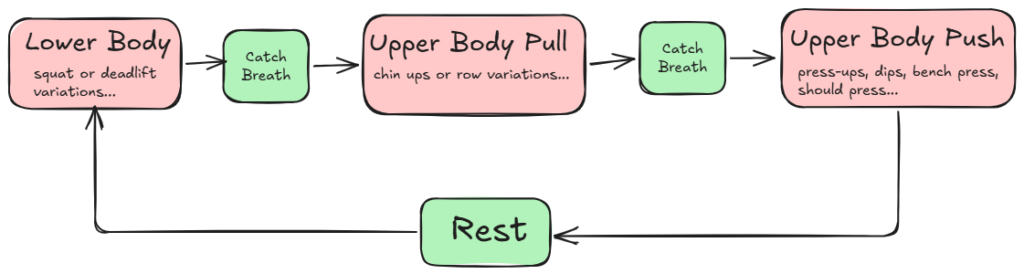
In the beginning, “catching your breath” might take 45 seconds or more after doing squats, but over time as your capacity improves it will reduce to 20-30 seconds or even less. In this setup each muscle group is rested while another is worked. So let’s say I do some squats then I catch my breath. Then I go on to do some chin-ups – catch breath again before doing press-ups and then have 90 second rest before repeating the same sequence again. So each round might take around 3 minutes. This also means each muscle group gets roughly 3 to 5 minutes of recovery – not from resting passively, but from the time spent doing the other two exercises plus the 90-second rest at the end of the round. Most people rest this long between heavy squat sets, yet in that same window you’ve completed a full set of all three exercises. This makes it one of the most time-efficient ways to train when you are on a tight schedule.
Progression method
I use straight sets with double progression in the 4-6 rep range, though you can apply the same approach to whatever range suits you like 6-8, 8-10. I personally like to stick to the low to moderate rep range between 4 to 10.
Here’s how it works in practice:
| Session | Verdict |
| Workout 1: 120kg Squat reps in each set: 6 – 6 | You got all the reps. Increase the weight next session (add 2.5kg) |
| Workout 2: 122.5kg Squats reps in each set: 5 – 5 | Keep the weight the same for the next workout. |
| Workout 3: 122.5kg Squats reps in each set: 6 – 6 | You got all the reps. Increase the weight next session (add 2.5kg). |
| Workout 4: 125kg Squats reps in each set: 4 – 3 | If you hit a set below the bottom rep range keep the same weight for the next workout. But if it happens again then lower the weight by 2.5kg or 5kg for the next workout. |
A note on quality: some sessions your progression won’t show up in extra reps, but in better technique and cleaner execution. That counts as progress too. Never grind out sloppy reps for the sake of hitting a number as it builds bad habits and will hold back your long-term development.
Why does my routine only consist of 2 sets per exercise?
I currently do just 2 sets per exercise. Rather than spreading energy across multiple sets, I put everything into two high-quality sets taken close to failure. This generates enough stimulus for strength and muscle growth without the unnecessary fatigue of extra volume that doesn’t contribute much to progression.
For this approach to work well, keep a few things in mind:
- It’s better suited to lifters with some experience rather than complete beginners.
- Stick to a low-to-moderate rep range, around 4-10 reps for compound movements.
- Don’t take both sets to absolute failure. Always keep 1-2 reps in the tank.
- Rest 3-5 minutes between sets.
- Only train twice a week, with 2-3 rest days between sessions. Full body routines suit this approach well.
If you want to explore this further, you can google the “2 sets method.”
Time Commitment
The whole thing takes me about an hour from door to door:
| Task | Time |
| Drive from home to gym | 10 min |
| Setup and warm-up in gym | 20 min |
| Execution of actual workout | 15 min |
| Drive from gym to home | 10 min |
| Shower/change | 10 min |
| TOTAL | 65 min |
I’ll try to post regular updates through videos and blog posts as the journey continues. Until next time.
Discover more from
Subscribe to get the latest posts sent to your email.